Koyasan Temple Stay: Which Shukubo to Book on Mount Koya
Twelve places to sleep on Koyasan, ten of them temples: what each serves for dinner, when its morning service starts, whether it holds a fire ritual, its bath and its gate time, with each temple's own price where it prints one.
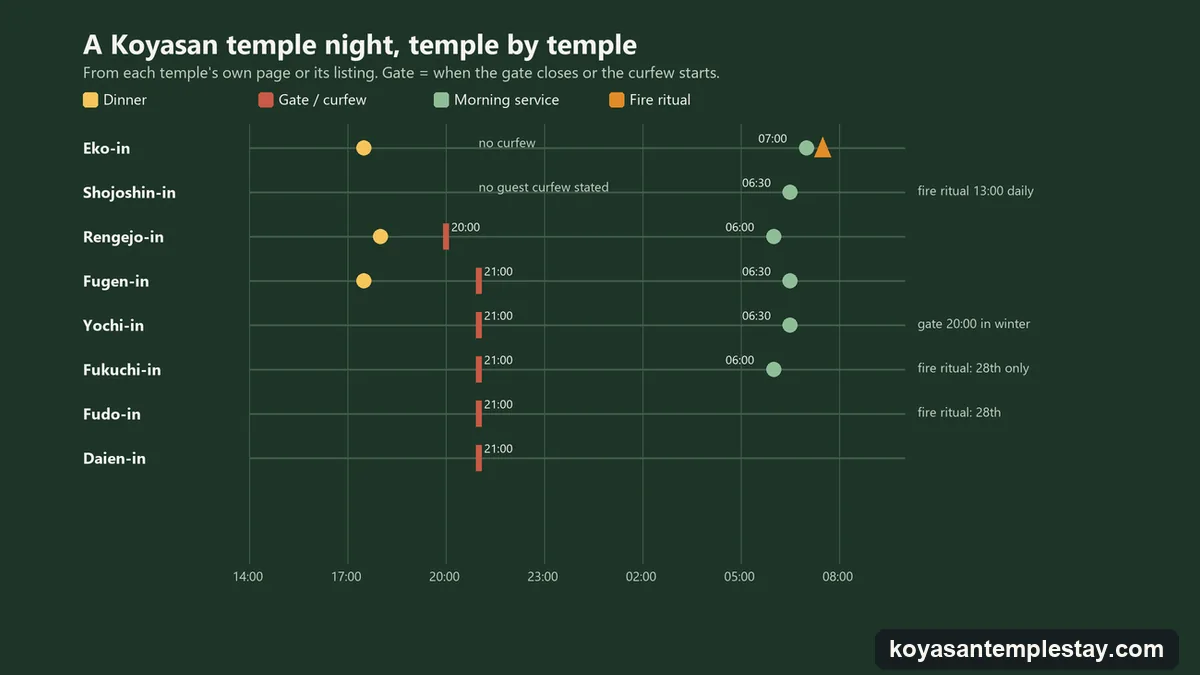
For a first Koyasan temple stay, sleep at the Okunoin end of town. Eko-in, a minute from the Ichinohashi entrance to the Okunoin cemetery, holds its morning service at 07:00 and a fire ritual at 07:30 every day, sets no curfew, and its own booking page priced a compact room with dinner and breakfast at JPY 40,000 a night for 2 on 14 December 2026. Shojoshin-in stands at the bridge itself. Choose a temple in the centre or the west for Kongobu-ji and the Danjo Garan, Fukuchi-in for a natural hot-spring bath, and Kokuu or Tommy if you want a guesthouse rather than a temple.
Which temple for your trip
Find your reason for going: each row opens the temples that answer it.
Ten temples and two guesthouses, grouped by where they sit on the mountain. Every button opens that lodging with the rooms and rates for the nights you pick.
The Okunoin end: a minute from the cemetery entrance
For the evening and early-morning walk in Okunoin. Kongobu-ji and the Garan are 15 minutes away on foot.
Scores and review counts come from the booking site behind these cards. Each "from" figure is the lodging's own booking page, for 2 adults on the night named beside it; a lodging with no public rate says so. Open a card to see your own nights.
Shukubo on Mount Koya, end by end
What a Temple Night Includes, Where Each Temple Sits and What It Costs
The evening and the morning in a shukubo, the temples side by side, the three ends of town, each temple's own price, the two guesthouses, booking direct and the catch.
What a Night in a Shukubo Includes
A shukubo is a temple that takes overnight guests. Koyasan has more than fifty of them: Fukuchi-in’s own page counts 52 among the 117 temples on the mountain. The night follows the temple’s day, not a hotel’s:
Arrival by about 17:00. Check-in usually opens at 14:00 or 15:00, and several temples ask you to be in by 17:00 if you want dinner.
Dinner at about 17:30: shojin ryori, the Buddhist vegetarian cooking of the monasteries, with no meat or fish. Eko-in serves it in your room; others in a dining hall.
The bath. Most temples have a shared bath, separate for men and women, open in the evening; few rooms have their own.
The gate. Most temples close their gate at 21:00 or earlier. Eko-in sets no curfew; Rengejo-in closes at 20:00.
The morning service at 06:00 to 07:00 in the main hall, with chanting; at some temples a fire ritual (goma) follows.
Breakfast, then check-out at 09:00 or 10:00.
The temple night, lodging by lodging: when the gate closes, when the morning service starts and which temples hold a fire ritual, as each temple gives them.
The temple comparison sets out each temple’s dinner, morning service, fire ritual, bath and price.
Where the Temples Sit on the Mountain
Koyasan is one long town on a plateau about 800 m up, strung along one main road. The Daimon gate closes it in the west; Kongobu-ji, the head temple, and the Danjo Garan are in the centre; at the east end, the Ichinohashi bridge opens onto Okunoin, the cemetery path to Kobo Daishi’s mausoleum. The cable car arrives outside town, at Koyasan Station, and buses run in from there.
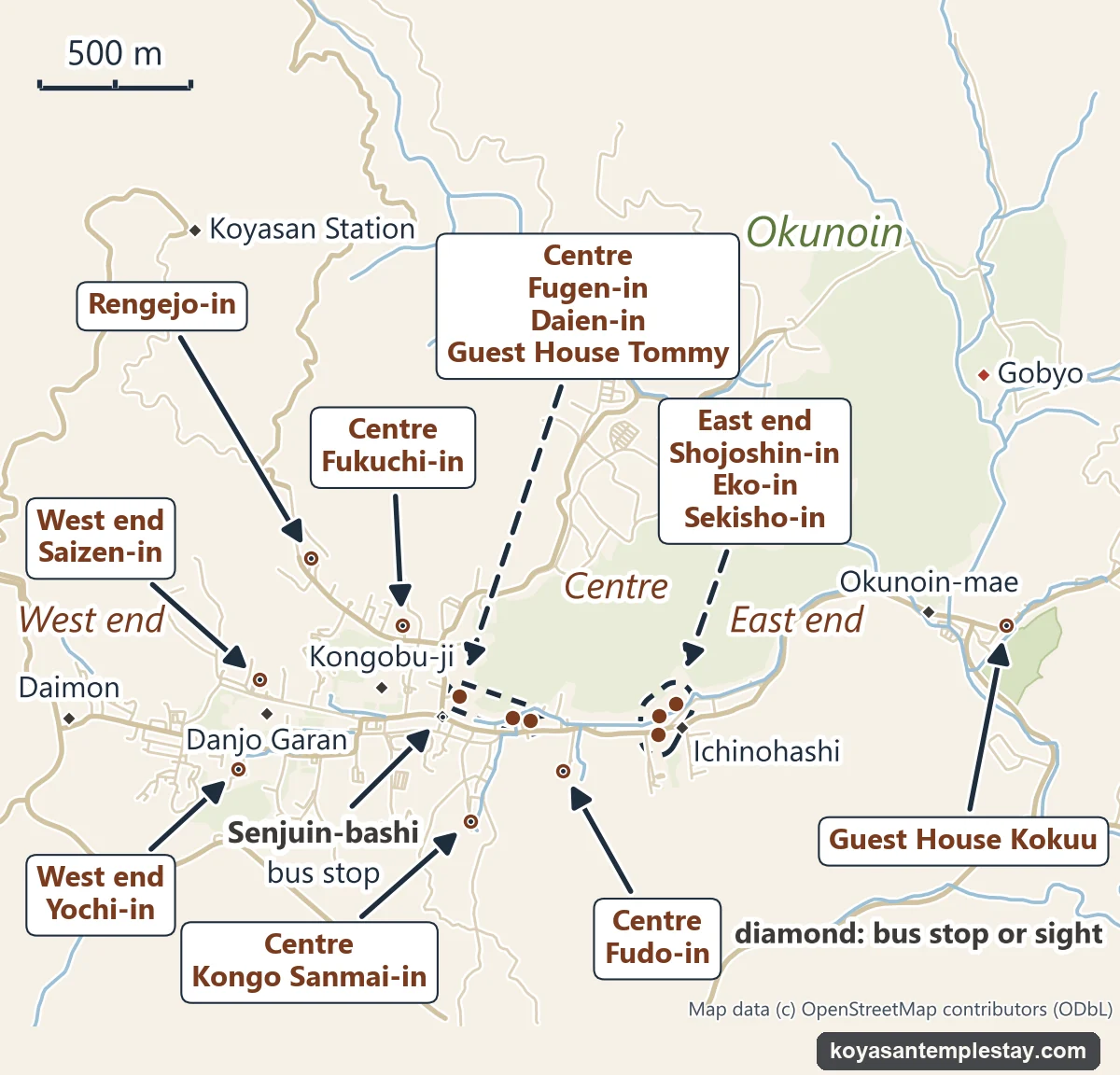
The temple lodgings by end of town: the Okunoin end (Eko-in, Shojoshin-in, Sekisho-in), the centre (Daien-in, Fudo-in, Fugen-in, Kongo Sanmai-in, Fukuchi-in, Tommy), the west (Saizen-in, Yochi-in, Rengejo-in) and Kokuu beyond Okunoin-mae.
The Okunoin end is for the evening and the early morning in the cemetery: Eko-in, Shojoshin-in and Sekisho-in are each within two minutes’ walk of Ichinohashi. Kongobu-ji is about 15 minutes away on foot.
The centre puts both halves of the town within reach: from Daien-in, Kongobu-ji is about 8 minutes on foot and Ichinohashi about 7. Fugen-in is 5 minutes from Kongobu-ji.
The west end is for Kongobu-ji, the Garan and the Daimon at dusk: Saizen-in is 7 minutes from Kongobu-ji, Yochi-in about 10. Okunoin is a bus ride.
Each temple prices its own rooms and plans, and the price moves with the date and the room. These are the rates the temples’ own booking pages showed for two adults on one stated December night, with dinner and breakfast:
Fukuchi-in, which books direct, priced its Basic Shojin Dinner plan at JPY 21,000 a person at two to a room on 21 December 2026. The other temples were full on the night asked for or showed no rate. The cost guide charts every figure and what moves it.
Two Guesthouses That Are Not Temples
Two places on Koyasan carry their own searches but are not shukubo. Guest House Kokuu, beyond Okunoin-mae, rents a Mountain Capsule at JPY 4,500 a night and a Double Bed Room at JPY 12,000 for two on its own price list, with shared bathrooms and a 22:00 curfew. Guest House Tommy, in the centre, has private rooms only, each with its own shower or bathtub. Neither serves a temple dinner or holds a morning service. See Kokuu and Tommy.
Booking Direct: the Temple or the Shukubo Association
You do not need a booking site to stay in a temple. Many temples sell rooms on their own websites, and the Koyasan shukubo association, the body of the mountain’s temple lodgings, books its member temples directly: instantly for the few temples it lists as bookable at once, and on request for the rest, when its office suggests a temple for your dates. The cards on this page open each temple’s listing on a booking site instead, where the room is confirmed at once and the cancellation terms are set out before you pay.
Two temples are not on the cards because they have no listing open for reservations on the booking site behind them: Fukuchi-in, with the only natural hot spring on Koyasan by its own account, and Hojo-in. Book them direct:
The gate. Most temples close at 21:00 or earlier and some at 20:00; a late dinner in town or a night walk needs a temple that lets you back in.
Shared bathrooms. Most temple rooms have no bath or toilet of their own; Sekisho-in’s new wing, some rooms at Saizen-in and Rengejo-in, and every room at Tommy do.
Cash. Saizen-in, Fudo-in, Fugen-in, Sekisho-in, Kongo Sanmai-in and Kokuu take cash at the door; Eko-in and Yochi-in also take cards, Daien-in and Rengejo-in take cards, not cash, and several temples’ own booking pages take payment in advance.
Children. Shojoshin-in takes adults only, Fudo-in guests over 13 and Rengejo-in children over 6; the others welcome children.
Dinner is fixed. It is vegetarian, served at one time, and most temples need you in by 17:00 for it.
Winter changes things. Yochi-in’s curfew moves to 20:00 from early December to mid March, Fukuchi-in closes its carbonated bath from December to March, the Kyoto bus does not run, and fewer weekend express trains climb the mountain; the winter guide has the detail.
Okunoin After Dark
The best of a temple night is the walk into Okunoin after dinner, when the day visitors have left. Okunoin at night covers the path, the guided evening walk and which temples let you back in late.
Getting Up the Mountain
From Osaka Namba, the Nankai Koya Line, the cable car and a bus take about 90 minutes on the Limited Express Koya; from Kyoto, ride to Namba first. Getting to Koyasan has the issuers’ fares and times, and the World Heritage Ticket bundles the train and two days of buses.
Every Bed on Koyasan on One Map
Every temple lodging, guesthouse and inn on the mountain, priced for your nights: the fallback when the temples above are full.
Book the Temple That Fits Your Evening
Eko-in, Shojoshin-in and Sekisho-in at the Okunoin end; Daien-in, Fudo-in, Fugen-in and Kongo Sanmai-in in the centre; Saizen-in, Yochi-in and Rengejo-in to the west; and the guesthouses Kokuu and Tommy, each with the rooms for your nights.
Cost, the best temple for you, how to book, the curfew, bathrooms, children, a guesthouse instead, and how long to stay.
On the temples' own booking pages, for two adults with dinner and breakfast on one December night: Saizen-in JPY 36,000 and Eko-in JPY 40,000 on 14 December 2026, Fudo-in JPY 40,000 on 17 December, and Rengejo-in JPY 42,000 on 14 December. Fukuchi-in prices per person: JPY 21,000 a person at two to a room on 21 December. Bigger rooms, rooms with their own bath and busy dates cost more.
For a first stay, Eko-in: it is a minute from the Okunoin entrance, holds a fire ritual every morning that guests attend, and sets no curfew. Shojoshin-in, at the Ichinohashi bridge, suits adults who want its daily 13:00 fire ritual. For a hot-spring bath, Fukuchi-in; for a room with its own bathroom, Sekisho-in or Saizen-in.
Yes. On Koyasan, temples that take overnight guests are called shukubo; the temples' own pages count 52 of them among the 117 temples on the mountain. You sleep in a tatami room, eat a vegetarian dinner and breakfast, and can join the morning service; some temples add a fire ritual or meditation.
Choose the end of town first. The Okunoin end (Eko-in, Shojoshin-in, Sekisho-in) is a minute from the cemetery path. The centre (Daien-in, Fudo-in, Fugen-in, Fukuchi-in) is between Kongobu-ji and Okunoin. The west end (Saizen-in, Yochi-in) is near Kongobu-ji and the Danjo Garan.
Three ways: on a temple's own website, where many sell rooms; through the Koyasan shukubo association, which books six temples instantly and the rest on request; or through the cards on this page, which open each temple with the rooms for your dates and confirm at once.
Most close their gate at about 21:00, Rengejo-in at 20:00. Eko-in sets no curfew. Shojoshin-in shuts its front gate to day visitors at 17:00 with a bell and states no curfew for guests: ask at its office how to come back in late. Yochi-in moves its curfew to 20:00 from early December to mid March.
Most do not: the standard rooms share toilets and a bath. Sekisho-in, Saizen-in, Rengejo-in, Eko-in and Fukuchi-in sell some rooms with their own bathroom, at a higher price. Every room at Guest House Tommy, a guesthouse, has its own shower or bathtub.
At most temples, yes, usually charged as adults from age 6. Shojoshin-in takes adults only, and Fudo-in takes guests over 13.
Guest House Kokuu is the nearest thing to a hostel: a Mountain Capsule for one at JPY 4,500 a night and a Double Bed Room at JPY 12,000 for two, on its own price list, with shared bathrooms. It is a guesthouse, not a temple, so there is no temple dinner or morning service.
You can: Nankai puts Namba to Koyasan at about 90 minutes on the Limited Express Koya. A night lets you add the morning service, the fire ritual and Okunoin after dark, which a day trip misses.
Walk into Okunoin after dinner, on your own or on the guided evening walk Awesome Tours runs, and check your temple's gate time first. Eko-in, a minute from the Okunoin entrance, sets no curfew.